SiVolt Solar needed a website that could explain an unfamiliar solar-cell contact technology to manufacturers, infrastructure investors and project developers. The starting point was a 26-page technical memorandum. Our task was to turn that material into a digital platform people could understand, interrogate and use as the starting point for a commercial conversation.
Ravensdale Digital delivered a five-page website with a bespoke visual system, scientific schematics, an interactive project-finance calculator and a structured data room request journey. The two-week project brought the technical proposition and its commercial implications into one accessible place.
Visit the live SiVolt Solar website.
The project at a glance
| Project detail | What we delivered |
|---|---|
| Client | SiVolt Solar |
| Sector | CleanTech, advanced photovoltaics and semiconductor engineering |
| Audience | PV manufacturers, equipment specialists, infrastructure investors, utilities and project developers |
| Scope | Content strategy, bespoke UI and UX, web development, financial modelling, technical SEO and hosting setup |
| Structure | Overview, Technology, Economics, Roadmap, Alliances & Contact |
| Delivery | Two weeks |
| Status | Live at sivolt-solar.com |
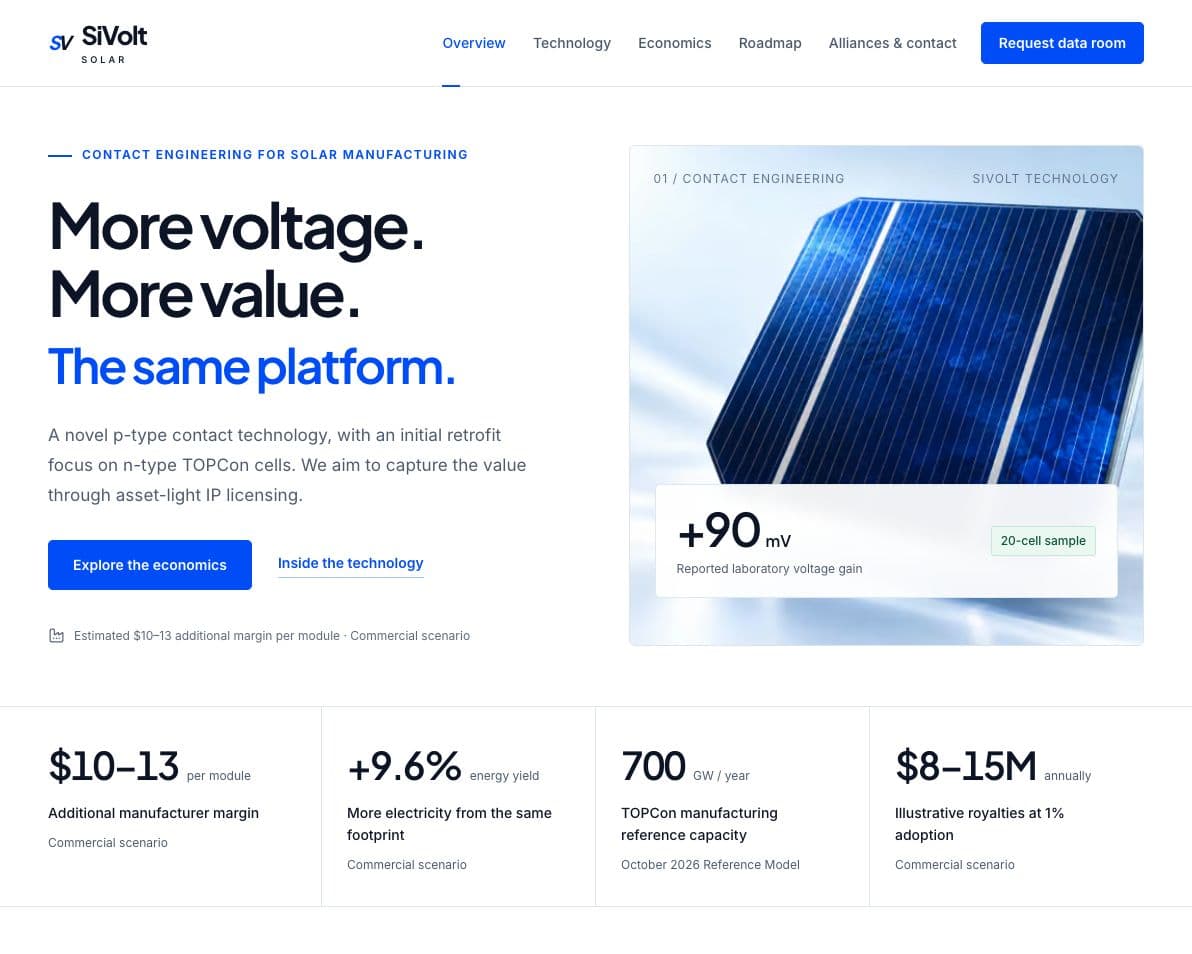
The homepage establishes the contact-engineering proposition before directing visitors towards the technology or its economics. Screenshots in this case study were captured from the live website in October 2026.
The client: contact engineering with a licensing model
SiVolt is developing a dual-layer p-type contact for n-type TOPCon crystalline-silicon solar cells. TOPCon stands for tunnel oxide passivated contact, an established cell architecture. SiVolt’s intended improvement sits at the front electrical interface, with a proposed retrofit route that preserves the underlying manufacturing sequence.
The business model centres on licensing intellectual property and process know-how into existing production. Manufacturers own the production assets; developers own the generating projects. SiVolt aims to earn royalties from adoption of its technology.
That distinction shaped the entire website. A visitor needed to understand the contact architecture, the intended integration pathway and the economic incentives for adoption. A generic solar-energy website would not explain those relationships clearly enough.
The challenge: clarity, positioning and evidence
Making dense technical material usable
The memorandum combined semiconductor physics, manufacturing considerations, licensing assumptions and project-finance mechanics. Each subject mattered, but presenting them all at once would make the website difficult to navigate.
We needed a hierarchy: an understandable overview first, followed by technical detail, commercial scenarios and the evidence required for the next stage. An engineer could investigate the contact concept while an investor could move directly to the licensing model or project returns.
Establishing an industrial identity
SiVolt’s audience was evaluating semiconductor technology and industrial integration. The website therefore needed the visual language of engineering: precise diagrams, restrained colour, clear labels and readable numbers.
We put the contact technology and its commercial context at the centre of the design. The result gives manufacturers and investment teams a relevant starting point for their assessment, without relying on the familiar residential solar sales format.
Building credibility before industrial validation
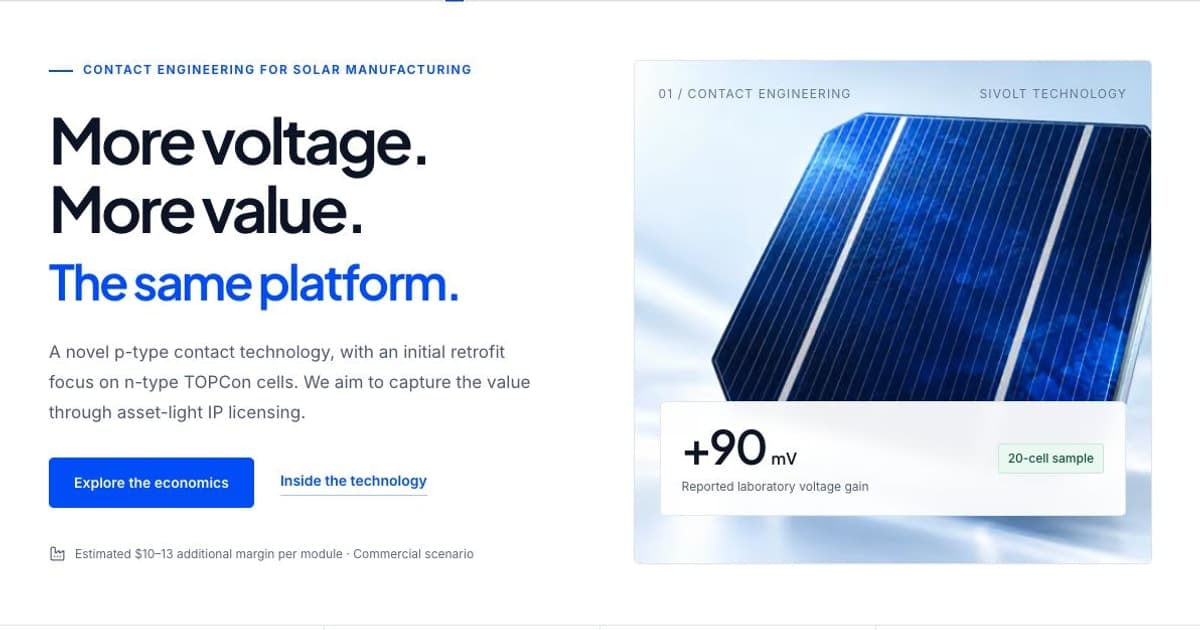
The central communication challenge was to show a promising laboratory result alongside the work still required for commercial adoption. The live site reports an approximately +90 mV voltage gain on a 20-cell sample. Industrial replication, module reliability and measured field performance remain further milestones.
We made those distinctions visible throughout the experience. Reported laboratory evidence, development targets and financial scenarios have their own labels. The roadmap explains what each next stage needs to establish. Visitors can assess both the opportunity and the remaining validation work.
Strategy: one technology, two value pools
We organised the commercial story around two audiences with different reasons to care about the same technology.
For manufacturers, the question is whether a process improvement can create additional module value at an acceptable incremental cost. SiVolt’s reference scenario estimates $10–13 in additional margin per module, with factory economics still subject to pilot validation.
For developers and financiers, the question is how additional delivered electricity changes project cash flows. The live reference model uses a 9.6% energy-yield uplift assumption, making it possible to explore revenue, equity returns and debt coverage for the same project footprint.
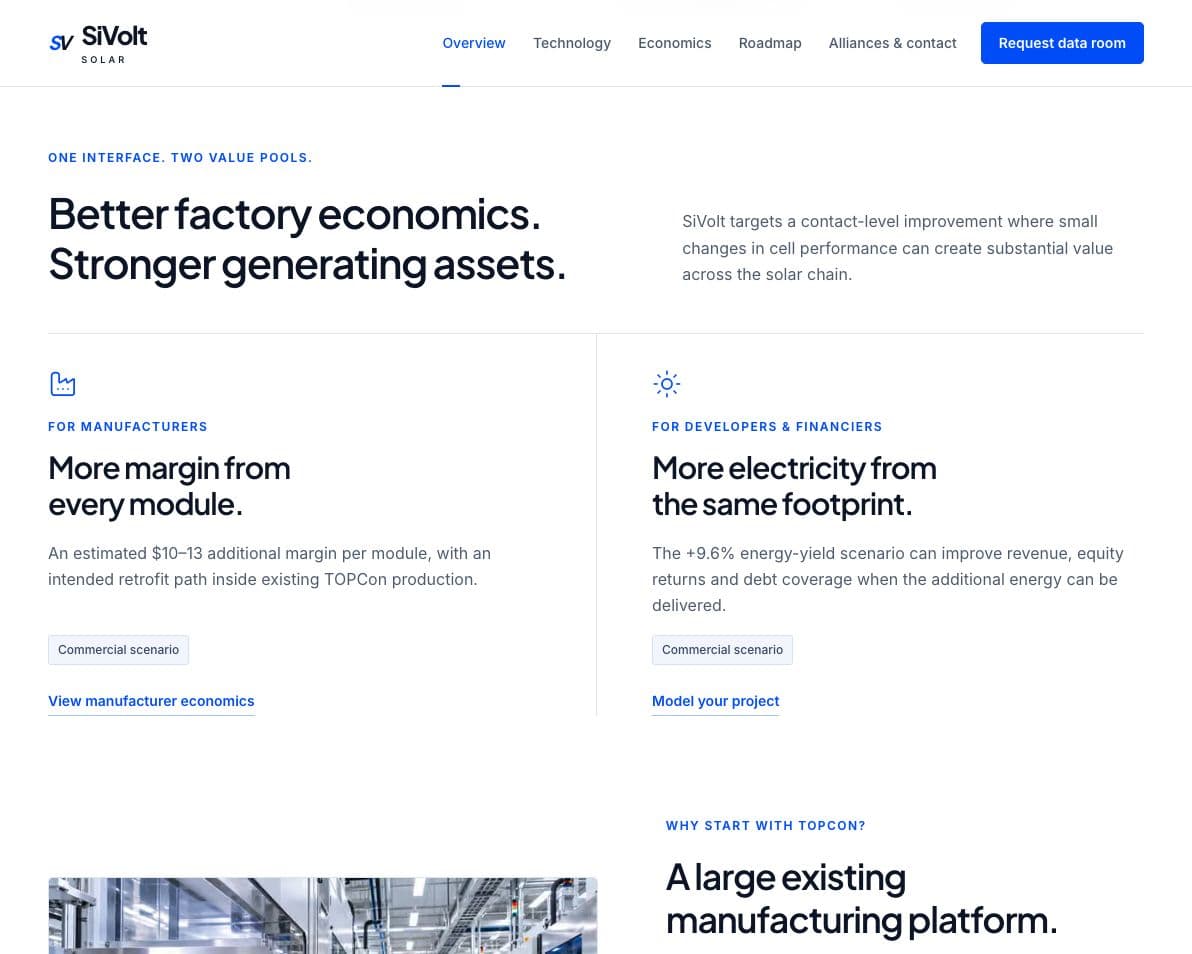
Two audience paths keep the homepage concise while allowing each visitor to follow the economic question relevant to them.
The licensing story then connects those benefits to SiVolt’s own business model. Its October 2026 Reference Model uses 700 GW per year of TOPCon manufacturing capacity as a reference assumption. We present that figure as part of the company’s model, rather than treating it as a measured result of this website project.
Design: silicon, voltage and financial clarity
The visual system uses a light background, deep silicon-inspired slate for contrast, voltage blue for primary actions and engineering emphasis, and emerald accents for positive modelled financial differences.
Clear headings, generous spacing and consistent metric treatments help readers move between narrative and numbers. Technical and financial information stays readable, with monospaced readouts where precision matters. The darker calculator panel gives the results a distinct visual focus within the otherwise light interface.
The design also gives the scientific explanation a concrete form. We built side-by-side conceptual schematics for conventional TOPCon and the SiVolt contact concept, showing where the two proposed layers sit in relation to the metal contact and silicon substrate.
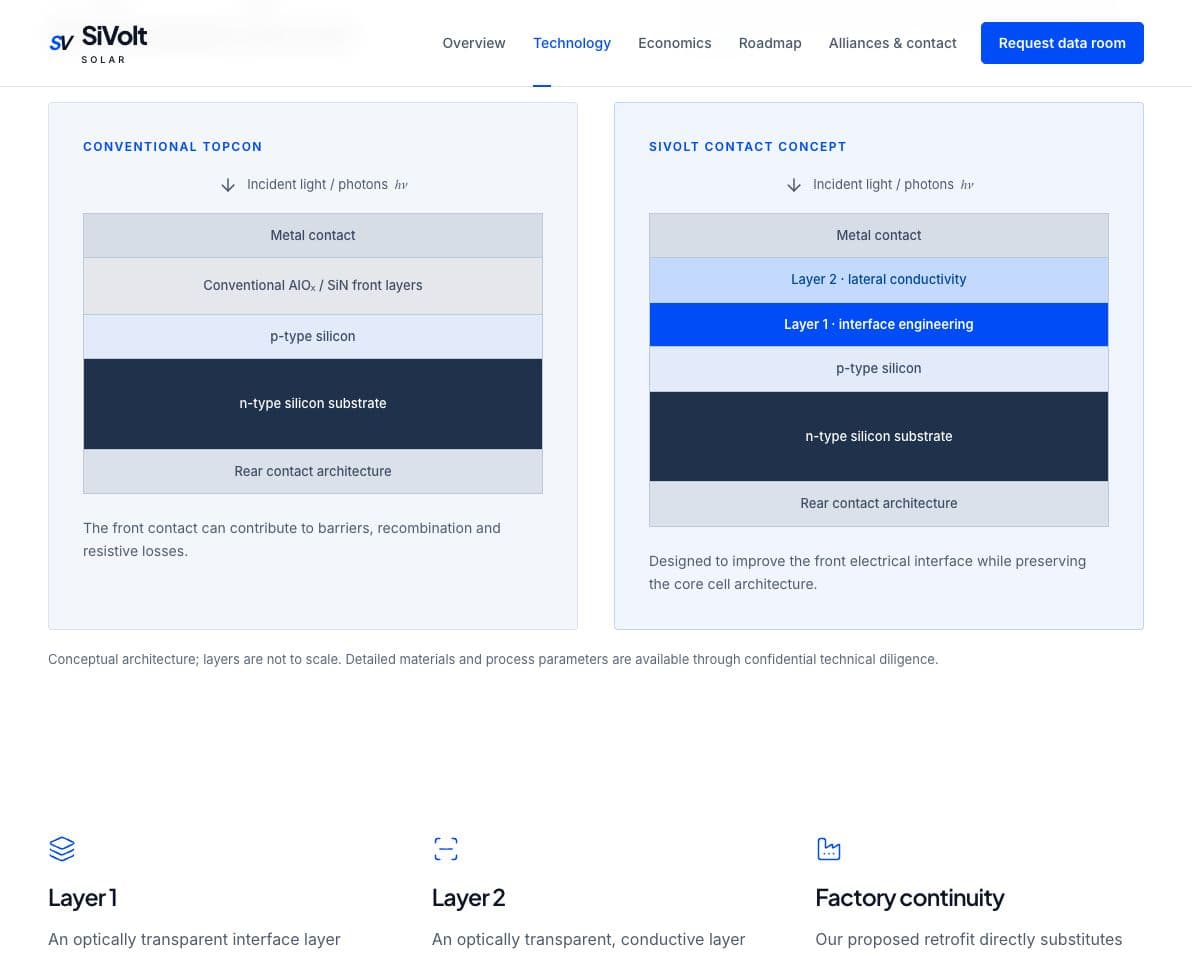
The diagrams explain the proposed architecture. They are conceptual and not to scale; detailed materials and process parameters belong in technical diligence.
This is a useful role for custom web design in DeepTech: a diagram can answer a structural question faster than several paragraphs, while the surrounding copy explains what has been demonstrated and what remains to be tested.
Development: an interactive project-finance model
The Economics page turns a headline yield assumption into an editable comparison. Visitors can change project capacity, annual baseline generation, electricity price and realised energy uplift, then inspect the effect on the modelled returns. A separate panel exposes finance assumptions.
The calculator compares annual cash flows for the conventional case and the SiVolt scenario. It shows project internal rate of return (IRR), equity IRR and the debt-service coverage ratio (DSCR), alongside generation and revenue. These measures give the reader different views of the same underlying cash-flow model.
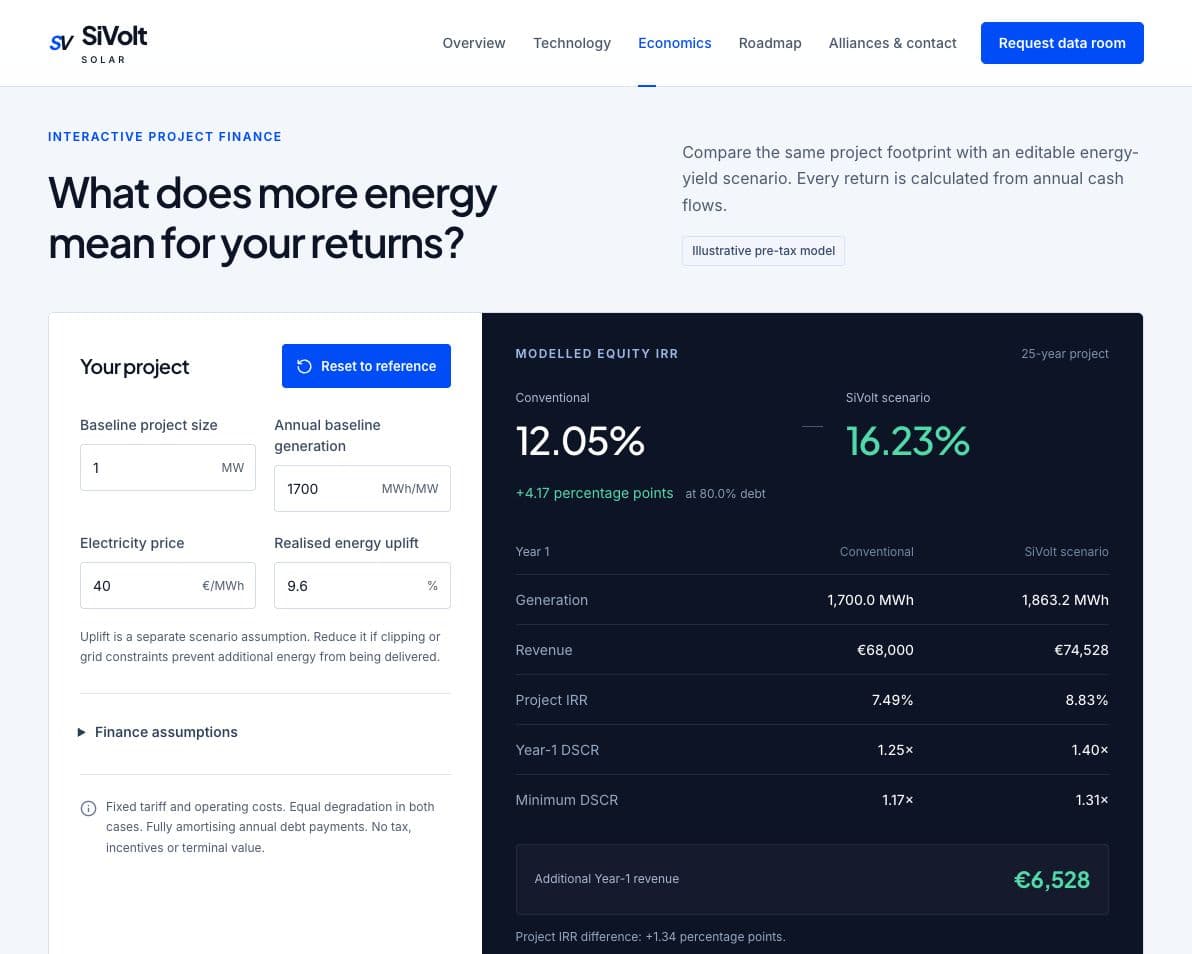
The reference case shown on the live website uses a 1 MW project, baseline annual generation of 1,700 MWh per MW, an electricity price of €40 per MWh and a 9.6% realised energy uplift. At its displayed finance settings, the comparison produces:
| Reference-model output | Conventional case | SiVolt scenario |
|---|---|---|
| Year-1 generation | 1,700 MWh | 1,863.2 MWh |
| Year-1 revenue | €68,000 | €74,528 |
| Project IRR | 7.49% | 8.83% |
| Equity IRR | 12.05% | 16.23% |
| Year-1 DSCR | 1.25× | 1.40× |
The model therefore shows €6,528 in additional Year-1 revenue and a 4.17 percentage-point difference in equity IRR for that reference scenario.
The annual equity cash-flow chart adds another layer of explanation: it shows the change after senior debt is retired following Year 15. An expandable cash-flow table allows visitors to inspect annual figures and the initial investment instead of relying only on headline percentages.
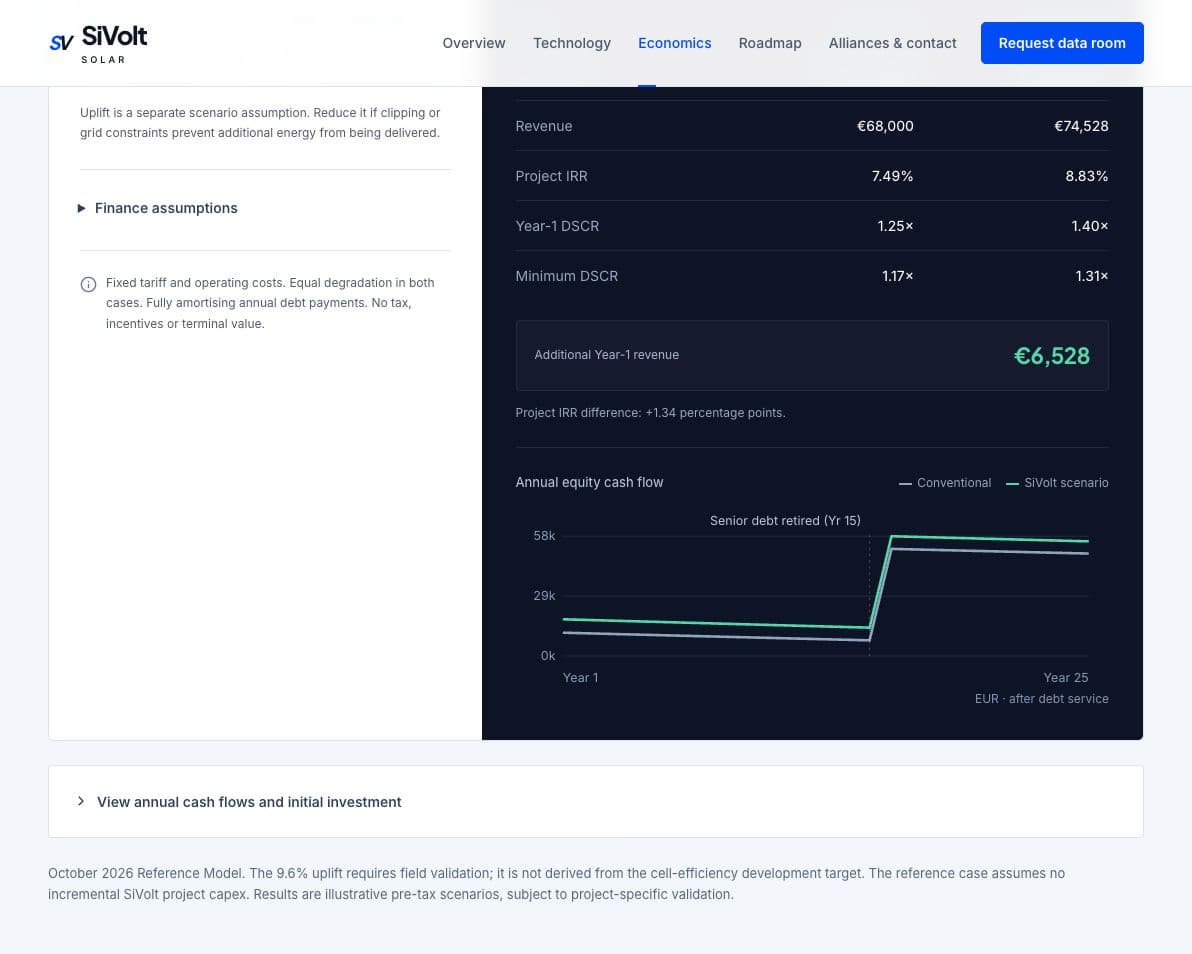
The benefit of the calculator is practical. A developer can reduce the realised uplift where grid constraints or clipping would limit delivered energy. An investor can examine finance assumptions. Both can use the same model as the basis for a more specific conversation.
Try SiVolt’s live project-finance calculator.
A roadmap that makes the next evidence clear
We gave validation its own page so that the website could explain the path from a laboratory signal to industrial confidence. The five stages cover laboratory contact proof, industrial-format replication, pilot manufacturing, module reliability and measured field performance.
Each stage describes the evidence needed to progress. That includes independent replication, statistically meaningful batch results, factory throughput and yield, module testing, and operating data that developers and lenders can assess.
This structure also prevents the approximately 27% cell-efficiency development target from being confused with an achieved commercial result. Equipment suppliers are presented as integration candidates; their inclusion does not imply confirmed partnerships or commercial agreements.
View the validation and bankability roadmap.
An enquiry journey for commercial diligence
The Alliances & Contact page brings visitors to a structured data room request form. It asks for an organisation, business email, area of interest and a short explanation of the enquiry, giving the client useful context for reviewing a request.
The categories reflect the actual audience: institutional investors and infrastructure funds, PV manufacturers, deposition equipment suppliers, utilities and project developers, and technical certification partners.
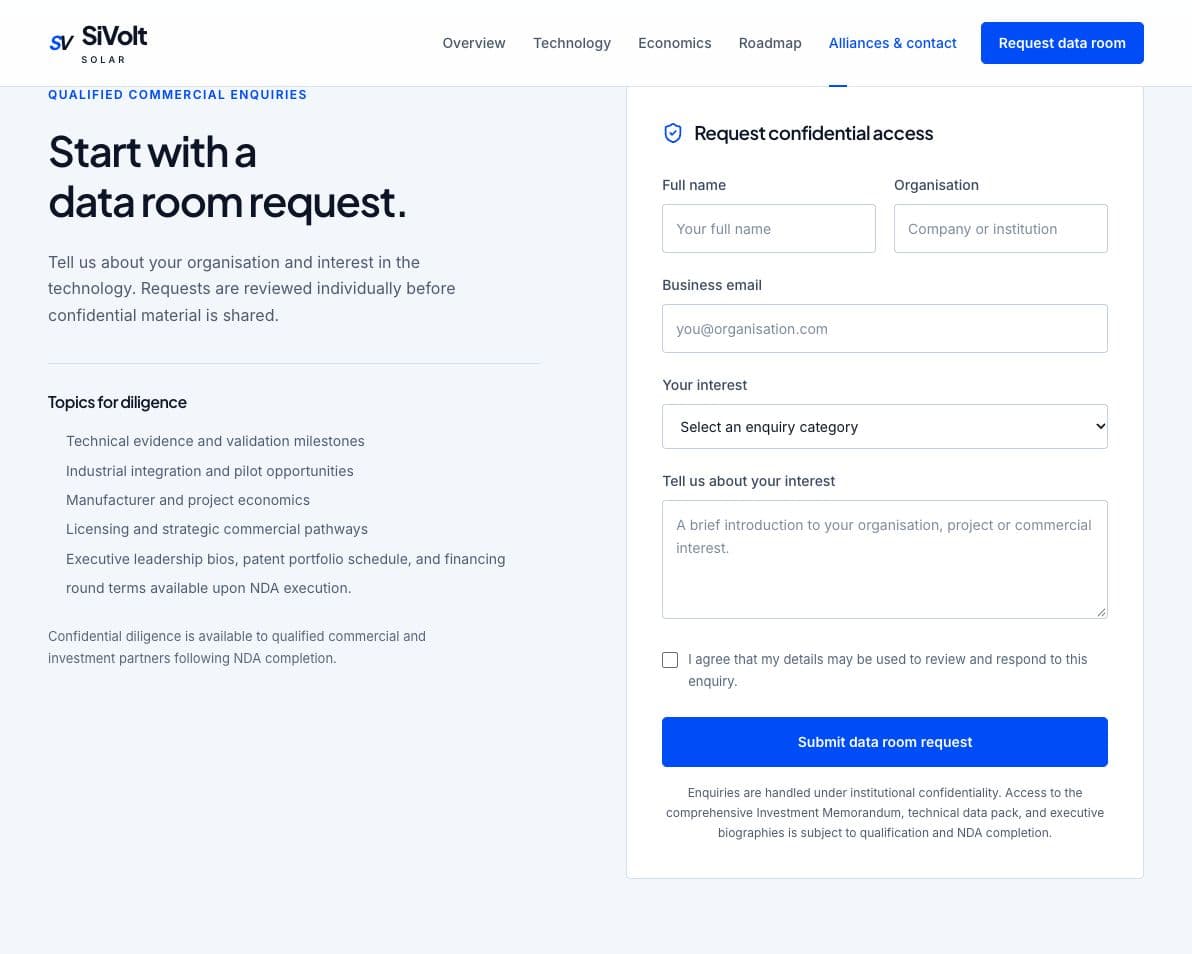
The page explains that requests are reviewed individually and that detailed material is shared after qualification and NDA completion. This is an entry point for diligence, with a clear next step for the visitor and a useful triage process for the client.
Delivery: five connected pages with search foundations
The finished website connects the Overview, Technology, Economics, Roadmap and Alliances & Contact pages through consistent navigation and contextual links. Each page has a specific job, while the whole experience supports a journey from initial understanding to further investigation.
The implementation combined semantic page structure, Tailwind CSS styling, custom JavaScript financial logic and responsive layouts. Supporting work included page-specific metadata, canonical URLs and Open Graph previews, so that shared links could introduce the relevant page clearly.
The deliverables brought together:
- Technical content strategy and British English copy.
- A bespoke visual identity and responsive interface.
- Conceptual contact-architecture diagrams and labelled commercial metrics.
- An editable project-finance calculator, cash-flow chart and supporting table.
- A staged validation roadmap and structured partner enquiry journey.
- Technical SEO foundations and deployment setup.
The outcome: a platform for informed conversations
The two-week delivery turned a technical memorandum into a live website where different audiences can evaluate the same proposition at the level they need. A manufacturer can inspect the integration concept; a project developer can explore the economics; an investor can review the licensing narrative and validation milestones.
The concrete result is a usable commercial platform: five connected pages, a working financial model, clear scientific illustrations and a route to request further information. The website gives SiVolt a consistent reference to share during investor and strategic partner conversations.
Its value comes from making the next question easier to ask. Visitors can see the proposed improvement, test the commercial assumptions and understand the evidence still required for adoption.
Visit SiVolt Solar to explore the finished experience.
Planning a DeepTech or climate-tech website?
A strong technical website needs a clear relationship between evidence, audience and commercial value. For SiVolt, that meant organising the physics, manufacturer economics, generating-asset scenarios and validation pathway into one coherent experience.
Ravensdale Digital helps teams build that structure and the custom tools needed to support it. Book a discovery call to discuss your venture, or read about our web development services and corporate website design.