How Much Does It Cost to Run an Online Directory?
A 2026 cost guide to running an online directory website, covering platform fees, hosting, development, listings, SEO, payments, moderation, maintenance, and marketing.
Jump to section
Online directories can look simple from the outside: a list of businesses, professionals, properties, suppliers, jobs, venues, or service providers.
Behind the scenes, a serious directory website has many moving parts. You need software, hosting, search, categories, member accounts, forms, payments, listing moderation, SEO content, email notifications, analytics, security, backups, and ongoing support.
So, how much does it cost to run an online directory?
For a small directory, the monthly running cost can be relatively low. For a professional membership, lead-generation, property, supplier, or marketplace directory, the real cost is higher because the website becomes an operational platform, not just a set of pages.
Quick answer: typical online directory cost ranges
These are broad planning ranges for South African businesses and founders. They are not fixed quotes, because the final cost depends on the platform, features, listing volume, design quality, automation, SEO requirements, payment setup, and support model.
| Directory type | Typical setup budget | Typical monthly running cost | Best suited for |
|---|---|---|---|
| Basic MVP directory | R8,000 – R25,000 | R300 – R2,000 | Testing a niche, small local directories, simple curated listings |
| WordPress plugin directory | R18,000 – R60,000 | R800 – R4,500 | Local business directories, niche supplier lists, professional listings |
| Brilliant Directories or hosted directory platform | R25,000 – R90,000+ | R1,500 – R8,000+ | Membership directories, paid listings, association websites, lead directories |
| Professional lead-generation directory | R60,000 – R180,000+ | R4,000 – R20,000+ | Directories that sell leads, subscriptions, featured placements, or advertising |
| Custom directory platform | R180,000 – R750,000+ | R12,000 – R80,000+ | Marketplaces, portals, property platforms, complex workflows, high-traffic platforms |
What makes an online directory expensive?
An online directory becomes more expensive when it needs to do more than display listings.
The cost usually increases when you need:
- Member registration and dashboards
- Paid listing plans
- Recurring subscriptions
- Featured listings
- Reviews and ratings
- Claim listing functionality
- Location-based search
- Map integrations
- Custom filters
- Lead forms and enquiry routing
- Payment gateway setup
- Email notifications
- Imported listings
- Duplicate listing cleanup
- SEO landing pages
- Blog or resource content
- Moderation tools
- Spam protection
- Custom design
- API integrations
- CRM or email marketing automation
- Advanced analytics
- Performance optimisation
- Ongoing support
A basic directory can be built quickly. A directory business needs planning.
The main cost categories
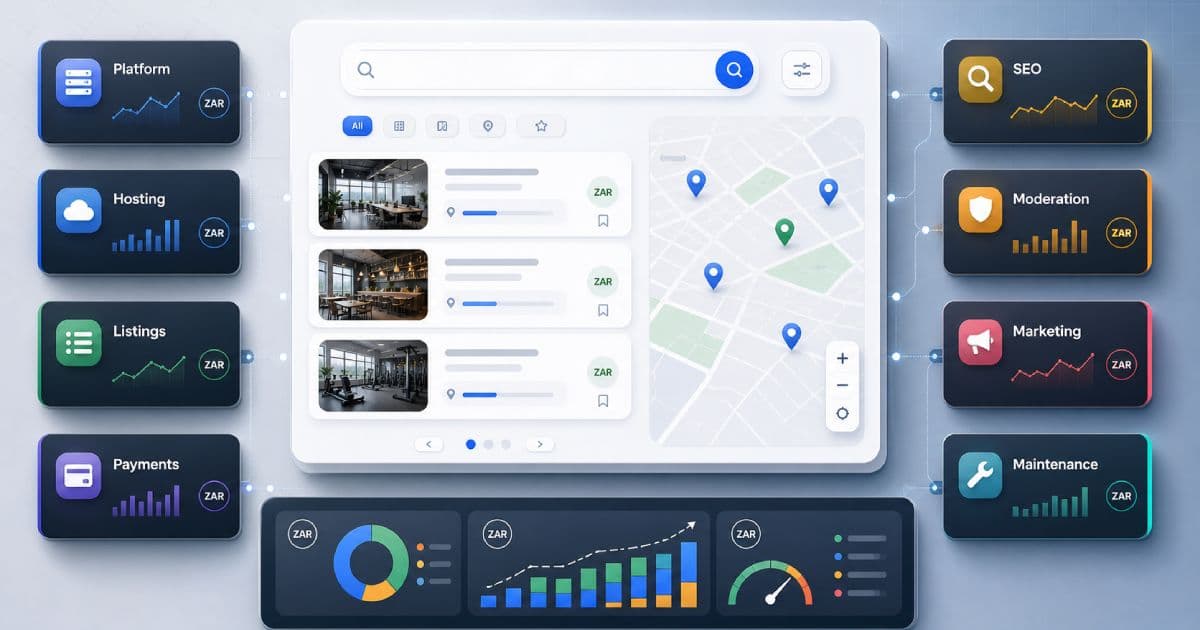
Most online directory projects have seven major cost areas.
| Cost category | What it includes | Why it matters |
|---|---|---|
| Platform and software | WordPress plugins, Brilliant Directories, custom code, marketplace tools | Controls what the directory can do |
| Hosting and infrastructure | Hosting, CDN, backups, email delivery, storage | Affects speed, reliability, and scalability |
| Design and development | Theme setup, custom templates, UX, mobile layout, listing pages | Affects credibility and conversion |
| Data and listings | Importing, cleaning, categorising, enriching, and moderating listings | A directory is only useful if the data is useful |
| SEO and content | Category pages, location pages, blog content, schema, internal linking | Helps users and search engines understand the directory |
| Marketing and growth | Outreach, social media, email, paid ads, partnerships | Brings businesses and users into the directory |
| Maintenance and support | Updates, backups, security, bug fixes, improvements | Keeps the directory stable after launch |
Platform options and how they affect cost
The platform you choose has a major impact on the initial budget, monthly cost, flexibility, and long-term control. Some projects are best handled through WordPress development, some through Brilliant Directories, and others through broader web development when the workflow is more custom.
Option 1: WordPress directory plugin
A WordPress directory is often the most affordable starting point. You can use plugins such as HivePress, GeoDirectory, Directorist, Business Directory Plugin, or custom post types with Advanced Custom Fields.
This approach can work well for:
- Local business directories
- Supplier directories
- Professional directories
- Property-related directories
- Service provider directories
- Small membership directories
- Niche content directories
Typical costs include:
| Item | Typical cost |
|---|---|
| WordPress hosting | R150 – R1,500+ per month |
| Premium theme or design work | R1,000 – R25,000+ |
| Directory plugin or extensions | Free – R8,000+ per year |
| Setup and configuration | R8,000 – R45,000+ |
| Custom development | R600 – R1,500+ per hour, depending on complexity |
| Maintenance | R500 – R5,000+ per month |
WordPress is flexible, but it needs proper maintenance. Plugin-heavy directories can become slow or fragile if they are not planned carefully.
Best for: directories that need flexibility, content marketing, SEO pages, WordPress publishing, and controlled development costs.
Option 2: Brilliant Directories or hosted directory software
Brilliant Directories and other hosted directory platforms can be a strong option when you want membership plans, listings, payments, member dashboards, and directory-specific features already built into the system.
This can reduce custom development time because many features are included or available through built-in modules.
It can work well for:
- Association directories
- Membership directories
- Lead-generation directories
- Local business directories
- Professional directories
- Industry portals
- Directories with paid listing plans
Typical costs include:
| Item | Typical cost |
|---|---|
| Platform subscription | Usually a monthly or annual software cost |
| Setup and configuration | R15,000 – R70,000+ |
| Design customisation | R8,000 – R50,000+ |
| Data import and cleanup | R2,500 – R40,000+ |
| Add-ons or integrations | Varies by platform and scope |
| Ongoing support | R1,500 – R10,000+ per month |
The trade-off is that hosted platforms may have less low-level code control than a custom build. However, they can be faster and safer than trying to assemble a complex membership directory from many unrelated plugins.
Best for: directory owners who want a proven directory structure, member management, listing plans, and lower technical overhead.
Option 3: Custom directory or marketplace
A custom directory is more expensive, but it gives you the most control. This may be built with Laravel, Next.js, Node.js, Django, or another modern web development stack.
A custom build makes sense when the directory needs:
- Complex search logic
- Advanced filters
- High listing volume
- Custom user dashboards
- Role-based permissions
- API integrations
- Lead routing rules
- Custom payment logic
- Marketplace functionality
- Multi-location or multi-country architecture
- Performance at scale
- Unique business workflows
Typical costs include:
| Item | Typical cost |
|---|---|
| Discovery and technical planning | R10,000 – R50,000+ |
| UX/UI design | R20,000 – R120,000+ |
| Custom development | R120,000 – R750,000+ |
| Hosting and infrastructure | R1,500 – R25,000+ per month |
| Maintenance and improvements | R8,000 – R80,000+ per month |
| Security, monitoring, and backups | R1,000 – R15,000+ per month |
Best for: funded platforms, marketplace businesses, directories with unique workflows, high-value lead generation, or long-term product ambitions.
Once-off setup costs
The setup cost depends on how much work is needed before launch.
Common once-off setup items include:
| Setup item | Typical budget range |
|---|---|
| Strategy and directory planning | R5,000 – R25,000+ |
| Platform setup | R5,000 – R35,000+ |
| Theme or UI customisation | R8,000 – R60,000+ |
| Custom listing fields | R3,000 – R25,000+ |
| Category and location structure | R2,500 – R20,000+ |
| Payment gateway setup | R2,500 – R15,000+ |
| Listing import | R2,500 – R50,000+ |
| SEO setup | R5,000 – R45,000+ |
| Analytics and tracking | R2,500 – R15,000+ |
| Testing and launch support | R5,000 – R30,000+ |
Monthly running costs
Monthly costs depend on the size of the directory, traffic level, platform, support needs, and marketing activity.
| Monthly item | Typical range |
|---|---|
| Hosting or platform subscription | R150 – R8,000+ |
| Email delivery and transactional emails | R0 – R2,000+ |
| Backups and security | R300 – R3,000+ |
| Maintenance and updates | R500 – R10,000+ |
| Content and SEO | R2,500 – R30,000+ |
| Listing moderation | R1,500 – R20,000+ |
| Marketing and outreach | R3,000 – R50,000+ |
| Automation tools | R300 – R5,000+ |
| Map, search, or API usage | R0 – R10,000+ |
| Analytics and reporting | R0 – R5,000+ |
For a small owner-managed directory, monthly costs may be modest. For a directory that depends on traffic, paid members, lead generation, and regular content, monthly operating costs can become a serious business expense.
The cost of listings and data
Many people underestimate the work required to build a useful listing database.
You may need to budget for:
- Manual data collection
- Spreadsheet cleanup
- Duplicate removal
- Category mapping
- Location formatting
- Logo and image handling
- Description writing
- SEO-friendly listing copy
- Contact details verification
- Import testing
- Ongoing listing updates
- Business claim workflows
A directory with 100 carefully edited listings can be more valuable than one with 10,000 low-quality listings. Poor data creates user frustration and can damage trust.
SEO costs for directory websites
SEO is especially important for directories because many directories depend on category, location, and long-tail search traffic.
A directory SEO plan may include:
- Category landing pages
- Location landing pages
- Listing page templates
- Internal linking
- Schema markup
- Helpful blog content
- Local SEO structure
- Indexation control
- Duplicate content management
- Thin page prevention
- XML sitemap setup
- Redirects from old URLs
- Google Search Console monitoring
Directory SEO is not only about creating thousands of pages. In many cases, too many thin pages can hurt quality. It is better to create useful pages with enough unique value, clear structure, and realistic search intent.
Monetisation affects cost
The way your directory makes money affects what you need to build.
| Monetisation model | Extra features needed |
|---|---|
| Free listings with ads | Ad placements, traffic growth, analytics, content strategy |
| Paid listings | Membership plans, payment gateway, billing emails, upgrade prompts |
| Featured listings | Listing priority, badges, admin controls, renewal logic |
| Lead generation | Enquiry forms, lead routing, notifications, tracking, reporting |
| Commission model | Marketplace payments, order flow, disputes, platform rules |
| Sponsored content | Content workflow, disclosure rules, reporting |
| Association membership | Member profiles, renewals, member dashboard, private content |
| Recruitment or job listings | Job post types, expiry dates, applications, employer accounts |
The more advanced the monetisation model, the more planning, testing, support, and automation you need.
Example budgets
Here are practical scenarios.
Scenario 1: Small local business directory
A local directory for a suburb, town, or niche group.
Typical setup:
- WordPress
- Directory plugin
- Basic categories
- Simple listings
- Contact forms
- Blog section
- Google Search Console
- Basic analytics
Estimated setup: R12,000 – R35,000 Estimated monthly cost: R500 – R3,000
This works best when the owner can help with data, content, outreach, and moderation.
Scenario 2: Professional niche directory
A directory for lawyers, estate agents, contractors, suppliers, clinics, schools, venues, or consultants.
Typical setup:
- WordPress or hosted directory platform
- Custom listing fields
- Search and filters
- Location pages
- Category pages
- Featured listings
- Claim listing option
- SEO content
- Analytics
- Maintenance plan
Estimated setup: R35,000 – R120,000 Estimated monthly cost: R2,500 – R12,000
This is a stronger model when the directory has a clear niche and a plan to attract both listed businesses and end users.
Scenario 3: Paid membership directory
A directory where members pay monthly or annually for profiles, leads, visibility, or access.
Typical setup:
- Member registration
- Paid plans
- Payment gateway
- Member dashboard
- Listing upgrades
- Email notifications
- Lead capture
- Admin approval workflows
- Content marketing
- Reporting
Estimated setup: R60,000 – R180,000+ Estimated monthly cost: R5,000 – R25,000+
This model needs good onboarding, support, renewal reminders, and a strong reason for members to keep paying.
Scenario 4: Custom lead-generation platform
A directory that sells leads, routes enquiries, tracks conversions, or serves multiple locations or verticals.
Typical setup:
- Custom development
- Advanced search
- Lead routing rules
- CRM integration
- Email/SMS notifications
- Admin dashboard
- Reporting
- API integrations
- Security and monitoring
- SEO architecture
- Content operations
Estimated setup: R180,000 – R750,000+ Estimated monthly cost: R15,000 – R80,000+
This is closer to building a software product than a normal website.
Costs many directory owners forget
When budgeting, remember these often-missed costs:
- Writing unique listing descriptions
- Cleaning imported data
- Creating category pages
- Creating location pages
- Preventing spam registrations
- Handling fake listings
- Moderating reviews
- Supporting members
- Updating expired listings
- Managing payment failures
- Creating email templates
- Building trust signals
- Tracking enquiries
- Improving low-performing pages
- Maintaining backups
- Testing plugin updates
- Protecting old URLs during rebuilds
How to reduce directory costs
You can keep costs under control by making focused decisions early.
Useful ways to reduce cost:
- Start with one niche instead of many industries
- Start with one country, province, city, or category
- Use a proven directory platform where possible
- Avoid unnecessary custom development
- Import only clean, useful data
- Keep listing fields simple at first
- Launch with fewer membership tiers
- Avoid paid ads until tracking is working
- Add automation only after the manual process is clear
- Build SEO pages around real demand, not every possible keyword
- Budget for maintenance from day one
A lean directory that solves one clear problem is usually better than a broad directory with no audience.
When a directory is worth building
An online directory is worth building when it has a clear reason to exist.
Good signs include:
- A defined niche
- Search demand
- Fragmented information in the market
- Businesses that want visibility
- Users who need comparison or discovery
- A way to keep listings accurate
- A monetisation model that makes sense
- A content or SEO plan
- A reason users would trust your directory
Bad signs include:
- “We want to be like Yelp” with no niche
- No plan to acquire listings
- No plan to attract search traffic
- No budget for content or moderation
- No clear reason businesses would pay
- Too many categories on day one
- Dependence on scraped data only
Final verdict
A basic online directory can be inexpensive to start, but a serious directory business needs more than software.
The real budget should include setup, data, SEO, hosting, maintenance, moderation, marketing, and ongoing improvement. If the directory needs paid members, lead generation, custom workflows, or high-quality SEO traffic, it should be treated as a business platform rather than a cheap website.
The safest approach is to start focused, prove the model, then invest in better search, automation, SEO, payments, and custom development as the directory gains traction.
Need help planning an online directory?
Ravensdale Digital Services can help you plan, build, customise, maintain, and grow online directories using WordPress, Brilliant Directories, ecommerce tools, automation, or custom development.
FAQs
How much does it cost to start an online directory?
A small directory can start from a modest setup budget if it uses WordPress and a directory plugin. A professional directory with custom design, SEO structure, payments, imported listings, and support usually needs a larger budget.
Is WordPress good for an online directory?
Yes, WordPress can work well for many directories, especially niche, local, professional, and content-driven directories. The main risk is using too many plugins without proper planning, performance optimisation, or maintenance.
Is Brilliant Directories worth it?
Brilliant Directories can be a good fit for membership directories, association websites, and paid listing models because many directory-specific features are already built in. It may be less suitable if you need full custom code control or highly unique workflows.
Can an online directory make money?
Yes, but not automatically. Common revenue models include paid listings, featured listings, subscriptions, lead generation, advertising, sponsorships, and premium content. The directory still needs traffic, trust, useful data, and a clear value proposition.
What is the biggest ongoing cost of a directory website?
For serious directories, the biggest ongoing cost is often content, SEO, listing management, moderation, member support, and marketing — not hosting.
Should I build a custom directory from scratch?
Only if the business model requires it. A custom build makes sense for complex search, lead routing, marketplace features, large-scale data, or unique workflows. For many early-stage directories, WordPress or a hosted directory platform is a better starting point.
Need help planning an online directory?
Ravensdale Digital Services can help you plan, build, customise, maintain, and grow online directories using WordPress, Brilliant Directories, ecommerce tools, automation, or custom development.