Local SEO Guide for South African SMEs
How to improve your visibility in Google Search and Maps with stronger local pages, Google Business Profile optimisation, reviews, citations, and measurement.
Jump to section
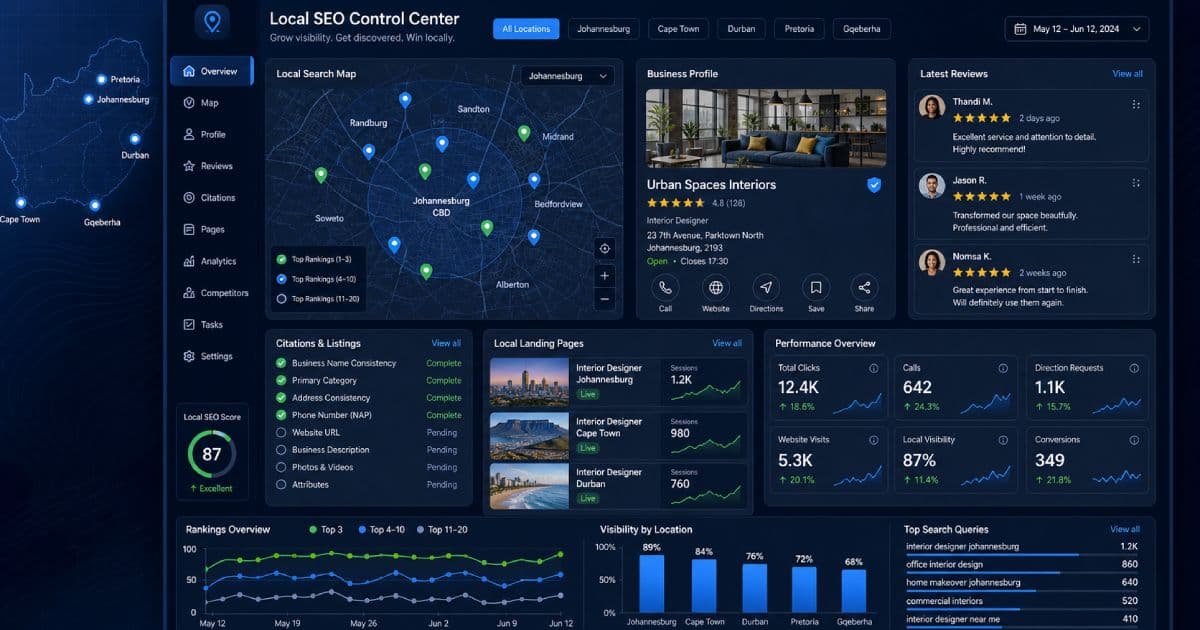
Local SEO helps people in your area find your business when they search for services, products, shops, contractors, consultants, clinics, restaurants, accommodation, or professional help nearby.
For many South African SMEs, local SEO is more valuable than broad national SEO. A plumber in Durban, an electrician in Gqeberha, a guest house in Knysna, a law firm in Cape Town, or a dentist in Sandton does not need traffic from everywhere. They need visibility in the places they actually serve.
Good local SEO is not one trick. It is the combined quality of your Google Business Profile, website, local pages, reviews, citations, content, links, technical setup, and customer experience.
What is local SEO?
Local SEO is the process of improving your visibility for searches with local intent.
These searches may include a place name, such as:
- plumber in Durban
- web designer in Port Elizabeth
- electrician Cape Town
- accounting firm in Pretoria
- bed and breakfast in Gqeberha
They may also be location-aware searches without a city name, such as:
- electrician near me
- closest dentist
- emergency plumber
- coffee shop open now
- website designer near me
Google can use the searcher’s location, the business location, the search query, the quality of business information, website content, reviews, and other signals to decide which businesses to show.
How Google thinks about local results
Google explains local ranking around three main ideas:
| Local ranking factor | What it means | What you can influence |
|---|---|---|
| Relevance | How well your business matches what someone searched for | Your business categories, services, website content, page titles, descriptions, and profile completeness |
| Distance | How close your business is to the searcher or searched location | Your real location or service areas, but you cannot fake proximity |
| Prominence | How well-known and trusted the business appears online | Reviews, links, citations, brand mentions, useful content, and overall reputation |
You cannot control everything. You cannot force Google to rank a business outside its real service area. You also cannot guarantee Map Pack rankings.
You can, however, make your business easier to understand, easier to trust, and easier to contact.
Step 1: Claim and verify your Google Business Profile
Your Google Business Profile is often the first local SEO asset to fix. It can appear in Google Search and Google Maps, and it may show your business name, category, reviews, address, service area, hours, photos, phone number, website link, products, services, updates, and directions.
Start by checking whether your business already has a profile. If it does, claim it. If not, create one.
Then verify it using the method Google offers. Verification matters because it gives you control over your business information.
Step 2: Choose the right business categories
Categories help Google understand what your business does.
Your primary category should describe the main service or business type. Secondary categories can cover other important services, but they should still be accurate.
Examples:
| Business | Better primary category | Possible secondary categories |
|---|---|---|
| Local electrician | Electrician | Solar energy contractor, electrical installation service |
| Law firm | Law firm | Conveyancer, attorney, legal services |
| Restaurant | Restaurant | Breakfast restaurant, family restaurant, takeout restaurant |
| Web agency | Website designer | Internet marketing service, graphic designer, marketing agency |
| Guest house | Guest house | Bed and breakfast, accommodation |
Avoid adding irrelevant categories just because they have search volume. That can confuse the profile and attract poor-quality enquiries.
Step 3: Make your NAP details consistent
NAP stands for:
- Name
- Address
- Phone number
These details should be consistent across your website, Google Business Profile, directories, social media profiles, and major business listings.
Consistency does not mean every page must be identical down to punctuation, but obvious mismatches can create confusion.
Common problems include:
- Using an old phone number
- Listing an old address
- Using different business names
- Mixing “Port Elizabeth” and “Gqeberha” without context
- Showing a branch location that no longer exists
- Listing a residential address when the business operates as a service-area business
- Having different opening hours across platforms
For South African businesses, it is often useful to include both current and commonly used place names where appropriate. For example, a Gqeberha business may still mention Port Elizabeth naturally because many customers continue to search that way.
Step 4: Optimise your Google Business Profile properly
A strong Google Business Profile should help customers make a decision quickly.
Review and improve these fields:
| Profile area | What to do | Why it matters |
|---|---|---|
| Business name | Use your real-world business name | Avoid keyword stuffing that may violate guidelines |
| Primary category | Choose the closest main category | Helps Google understand your core service |
| Secondary categories | Add only relevant extra services | Supports broader but accurate visibility |
| Address or service area | Use accurate location information | Helps with local relevance and customer trust |
| Phone number | Use a working number answered by the business | Reduces missed enquiries |
| Website link | Link to the most relevant page | Sends users to a page that matches their intent |
| Opening hours | Keep normal and holiday hours updated | Prevents frustration and poor customer experience |
| Services | Add clear service names and descriptions | Helps users understand what you offer |
| Products | Add products or packages where useful | Useful for shops, ecommerce, restaurants, clinics, and service bundles |
| Photos | Add real, high-quality images | Improves trust and helps customers recognise your business |
| Business description | Explain what you do clearly | Helps customers understand fit before contacting you |
Step 5: Build local service pages on your website
Your website should support your Google Business Profile.
Many SMEs make the mistake of relying only on the homepage. That works poorly when the business offers multiple services or serves multiple areas.
Instead, create clear pages for important services and locations.
Examples:
- /seo-services/
- /website-design-for-electricians/
- /plumbing-services-durban/
- /estate-agent-websites-south-africa/
- /local-seo-services-gqeberha/
- /emergency-electrician-cape-town/
Each page should be useful on its own. Do not create dozens of thin pages where only the city name changes.
A strong local service page should include:
- A clear H1
- The service and location in natural language
- Who the service is for
- What problems it solves
- What is included
- Local context where relevant
- FAQs
- Trust signals
- Calls to action
- Internal links
- Contact options
- Schema where appropriate
Step 6: Use local keywords without sounding robotic
Local keywords still matter, but they should be used naturally.
Good examples:
- SEO services for South African SMEs
- web design company in Gqeberha
- local SEO for electricians in Johannesburg
- ecommerce website development in Cape Town
- website maintenance for small businesses in South Africa
Poor examples:
- best cheap top SEO local business South Africa near me ranking company
- plumber Durban plumber in Durban best Durban plumber Durban
- Cape Town web design Cape Town website design Cape Town designer
Use local keywords in the places that matter:
| Page element | Example |
|---|---|
| Title tag | Local SEO Services for South African SMEs |
| H1 | Local SEO Services for Small Businesses in South Africa |
| Intro paragraph | We help South African SMEs improve visibility in Google Search and Maps. |
| URL slug | /local-seo-services/ |
| Image alt text | Team reviewing local SEO performance for a South African business |
| Internal links | See our SEO services for South African businesses |
| FAQ questions | How long does local SEO take in South Africa? |
The goal is to match how customers search while still writing like a real business.
Step 7: Create location pages carefully
Location pages can work well when they are genuinely useful.
They are risky when they are mass-produced.
A useful location page may include:
- Services available in that area
- Local customer needs
- Delivery, travel, or service area details
- Branch information if you have a real branch
- Local testimonials or case studies
- FAQs specific to the area
- Photos from real projects
- Links to related service pages
A weak location page usually has:
- Generic copy
- No unique local value
- City name swapped into the same template
- No real proof of serving that area
- No useful details for customers
Step 8: Add LocalBusiness structured data
Structured data can help search engines understand your business information more clearly.
For local businesses, LocalBusiness schema may include:
- Business name
- Address
- Phone number
- Opening hours
- Website URL
- Logo
- SameAs profile links
- Business type
- Geo coordinates where appropriate
- Service area where appropriate
Structured data is not a ranking shortcut. It is a way to make your business information clearer and more machine-readable.
If your site uses WordPress, a good SEO plugin may help generate basic schema. For custom websites, schema can be added directly in JSON-LD.
Step 9: Improve mobile speed and technical quality
Local searches often happen on mobile, especially when someone needs a quick answer, directions, a phone number, or a quote.
Your site should be fast, clear, and easy to use on a phone.
Check:
| Technical area | What to improve |
|---|---|
| Mobile layout | Buttons, forms, headings, and menus should work cleanly on small screens |
| Page speed | Compress images, reduce heavy scripts, and use good hosting |
| Contact options | Make phone, WhatsApp, email, and enquiry forms easy to find |
| Crawlability | Important pages should be indexable and linked internally |
| HTTPS | The site should use a secure SSL certificate |
| Redirects | Old URLs should redirect correctly after a rebuild |
| Metadata | Each important page should have a unique title and description |
| Analytics | Track calls, forms, clicks, and conversions where possible |
For businesses rebuilding an old site, technical SEO is especially important. Poor redirects, deleted pages, slow themes, or broken internal links can damage existing visibility. This is where website maintenance and technical support matter after launch.
Step 10: Build and clean local citations
A citation is a mention of your business information on another website. This may include directories, association websites, supplier portals, chamber of commerce pages, industry listings, social platforms, or local business directories.
Examples may include:
- Industry association directories
- Supplier directories
- Local chamber pages
- South African business directories
- Niche directories
- Real estate, legal, medical, trade, tourism, or hospitality listings
- Social profiles
- Partner pages
The aim is not to submit your business everywhere. The aim is to keep the important listings accurate.
Check for:
- Correct business name
- Correct phone number
- Correct website URL
- Correct address or service area
- Correct category
- Correct opening hours
- No duplicate listings
- No old domains or phone numbers
Step 11: Collect real reviews ethically
Reviews help customers evaluate whether they can trust your business.
Ask for reviews after a real service, purchase, project, consultation, delivery, or support interaction. Make the process easy, but do not pressure people.
Good review request examples:
- “Thanks for choosing us. If you were happy with the service, we’d appreciate an honest Google review.”
- “Your feedback helps other customers understand what to expect.”
- “Here is our review link if you would like to share your experience.”
Avoid:
- Paying for reviews
- Offering discounts in exchange for reviews
- Asking staff to write fake reviews
- Asking customers to change negative reviews for a reward
- Posting fake competitor reviews
- Review gating that only asks happy customers to leave public feedback
Google’s review policies are strict about fake and incentivised engagement. The safest review strategy is simple: ask real customers for honest feedback.
Step 12: Respond to reviews properly
Responding to reviews shows that the business is active and listening.
For positive reviews:
- Thank the customer
- Mention the service briefly
- Keep it natural
- Avoid keyword stuffing
- Do not reveal private details
For negative reviews:
- Stay calm
- Acknowledge the issue
- Avoid arguing publicly
- Invite the customer to contact you directly
- Explain what you are doing to improve where appropriate
Example response:
> Thank you for the feedback. We’re sorry the experience did not meet expectations. Please contact our team directly so we can review what happened and work towards a fair resolution.
A measured response can protect trust even when the review is not ideal.
Step 13: Add real photos and keep them fresh
Photos help customers decide whether a business feels real and trustworthy.
Add images such as:
- Exterior photos
- Interior photos
- Team photos
- Service vehicles
- Completed work
- Products
- Menu items
- Before-and-after photos where appropriate
- Reception or entrance photos
- Event or project images
Avoid using only generic stock photos. They rarely build local trust.
For service businesses, real work photos can be especially powerful. A contractor, electrician, landscaper, plumber, designer, clinic, or guest house should show evidence of real activity.
Step 14: Publish useful local content
Local content should answer questions customers actually ask.
For example:
| Business type | Useful local content ideas |
|---|---|
| Electrician | “When should you upgrade your DB board?” |
| Plumber | “What to do when a geyser bursts in South Africa” |
| Dentist | “How to choose a family dentist in your area” |
| Estate agency | “What buyers should know about transferring property in Gqeberha” |
| Restaurant | “Private function options for small events” |
| Web agency | “How much does a website cost in South Africa?” |
| Guest house | “Where to stay when visiting Addo Elephant Park” |
| Lawyer | “What documents are needed for conveyancing?” |
Good content supports local SEO because it improves topical relevance, internal linking, and customer trust.
It also gives your business more useful pages to share in WhatsApp, email, social media, and proposals. If local visibility is supported by campaigns, keep the website, content, and digital marketing activity aligned.
Step 15: Earn local links and mentions
Local links are difficult to fake, which is why they can be valuable.
Good link opportunities include:
- Sponsoring local sports teams
- Supporting community events
- Joining business associations
- Partnering with suppliers
- Getting listed on industry body websites
- Publishing expert commentary for local media
- Collaborating with local organisations
- Creating useful resources for your community
- Sharing case studies with partners and clients
A local link does not need to come from a famous website to be useful. A relevant link from a real local organisation can support trust and visibility.
Step 16: Track the right metrics
Do not measure local SEO only by rankings.
Rankings can change by location, device, search history, competition, and query wording. Track actions that matter to the business.
| Metric | Tool | Why it matters |
|---|---|---|
| Google Business Profile calls | Google Business Profile performance | Shows whether Search and Maps visibility is driving contact |
| Website clicks from profile | Google Business Profile performance | Shows whether people are moving from profile to site |
| Search queries | Google Search Console | Shows what terms are bringing impressions and clicks |
| Form submissions | GA4 or form tracking | Measures enquiries from the website |
| Phone clicks | GA4 event tracking or call tracking | Useful for mobile-first businesses |
| Traffic by city | GA4 | Shows which areas are engaging with the website |
| Landing page performance | Google Search Console and GA4 | Shows which local pages are working |
| Review growth | Google Business Profile | Tracks trust-building over time |
| Conversion rate | Analytics or CRM | Shows whether traffic is becoming business |
Step 17: Know when to hire a local SEO specialist
Many local SEO tasks can be handled in-house. But professional help may be worth it when:
- Your industry is competitive
- You serve multiple locations
- Your website has technical SEO problems
- You are rebuilding an old site with existing rankings
- Your Google Business Profile has issues
- You have duplicate or inconsistent citations
- Your content is thin or outdated
- You need proper tracking
- Your team does not have time to manage SEO consistently
Local SEO is not a one-day setup. It needs maintenance, measurement, and improvement. It can also overlap with GEO and AI search readiness when your business information needs to be clearer for search engines and AI-assisted discovery.
Quick-start local SEO checklist
Use this as a simple starting point.
| Task | Priority | Status |
|---|---|---|
| Claim and verify Google Business Profile | High | Not started / In progress / Done |
| Choose accurate primary and secondary categories | High | Not started / In progress / Done |
| Confirm name, address, phone, website, and hours | High | Not started / In progress / Done |
| Add real photos and logo | High | Not started / In progress / Done |
| Add services and products where relevant | Medium | Not started / In progress / Done |
| Create or improve key service pages | High | Not started / In progress / Done |
| Add local keywords naturally to titles and headings | Medium | Not started / In progress / Done |
| Add LocalBusiness schema where appropriate | Medium | Not started / In progress / Done |
| Clean important citations and directory listings | Medium | Not started / In progress / Done |
| Ask real customers for honest reviews | High | Not started / In progress / Done |
| Respond to reviews | Medium | Not started / In progress / Done |
| Improve mobile speed and contact options | High | Not started / In progress / Done |
| Connect Google Search Console and GA4 | High | Not started / In progress / Done |
| Track calls, forms, and profile actions | High | Not started / In progress / Done |
| Publish helpful local content | Medium | Not started / In progress / Done |
Common local SEO mistakes
Avoid these mistakes:
- Creating thin city pages with copied text
- Keyword-stuffing your Google Business Profile name
- Ignoring negative reviews
- Buying fake reviews
- Forgetting holiday hours
- Using old phone numbers in directories
- Rebuilding a website without redirects
- Hiding contact details
- Publishing generic AI-written service pages without local substance
- Tracking rankings but not leads
- Ignoring mobile speed
- Using only stock photos
- Submitting to every directory without checking quality
Final thoughts
Local SEO is one of the most useful marketing foundations for South African SMEs that rely on nearby customers.
Start with the basics: accurate business information, a complete Google Business Profile, strong service pages, real reviews, clean citations, mobile-friendly design, and measurement. Then improve from there with better content, stronger links, clearer calls to action, and ongoing optimisation.
The businesses that win locally are usually not the ones chasing tricks. They are the ones that make it easy for customers and search engines to understand who they are, where they operate, what they offer, and why they can be trusted.
Sources and further reading
- Google Business Profile: Tips to improve your local ranking on Google
- Google SEO Starter Guide
- Google LocalBusiness structured data
- Google Business Profile prohibited and restricted content
Need help improving your local visibility?
Ravensdale Digital Services can help South African SMEs improve local SEO, rebuild underperforming websites, fix technical SEO issues, optimise Google Business Profiles, and create content that supports real customer enquiries.
FAQs
How long does local SEO take?
Some fixes, such as updating your Google Business Profile or correcting contact details, can be done quickly. Meaningful improvements in visibility, traffic, and enquiries usually take longer because Google needs to understand the changes and compare your business with competitors.
Is Google Business Profile enough without a website?
A Google Business Profile is important, but it should not replace your website. Your website gives you more control over service pages, content, tracking, forms, case studies, landing pages, and SEO structure.
Should I create pages for every city I serve?
Only if each page is genuinely useful. If the pages are thin copies with only the city name changed, they may hurt quality. Build location pages where you can add real value, local relevance, service details, FAQs, and proof.
Can I ask customers for Google reviews?
Yes, you can ask real customers for honest reviews. Avoid fake reviews, paid reviews, incentives, review manipulation, or asking only happy customers while blocking others from reviewing.
What is the difference between local SEO and normal SEO?
Normal SEO focuses on improving search visibility generally. Local SEO focuses on searches tied to a place, service area, or nearby intent. It includes Google Business Profile optimisation, reviews, citations, local pages, and location-aware content.
Is local SEO useful for service-area businesses?
Yes. Service-area businesses such as plumbers, electricians, cleaning companies, landscapers, contractors, IT support providers, and consultants can benefit from local SEO. The key is to represent real service areas accurately and support them with useful website content.
Need help improving your local visibility?
Ravensdale Digital Services can help South African SMEs improve local SEO, rebuild underperforming websites, fix technical SEO issues, optimise Google Business Profiles, and create content that supports real customer enquiries.